How much should a freelancer set aside for taxes?
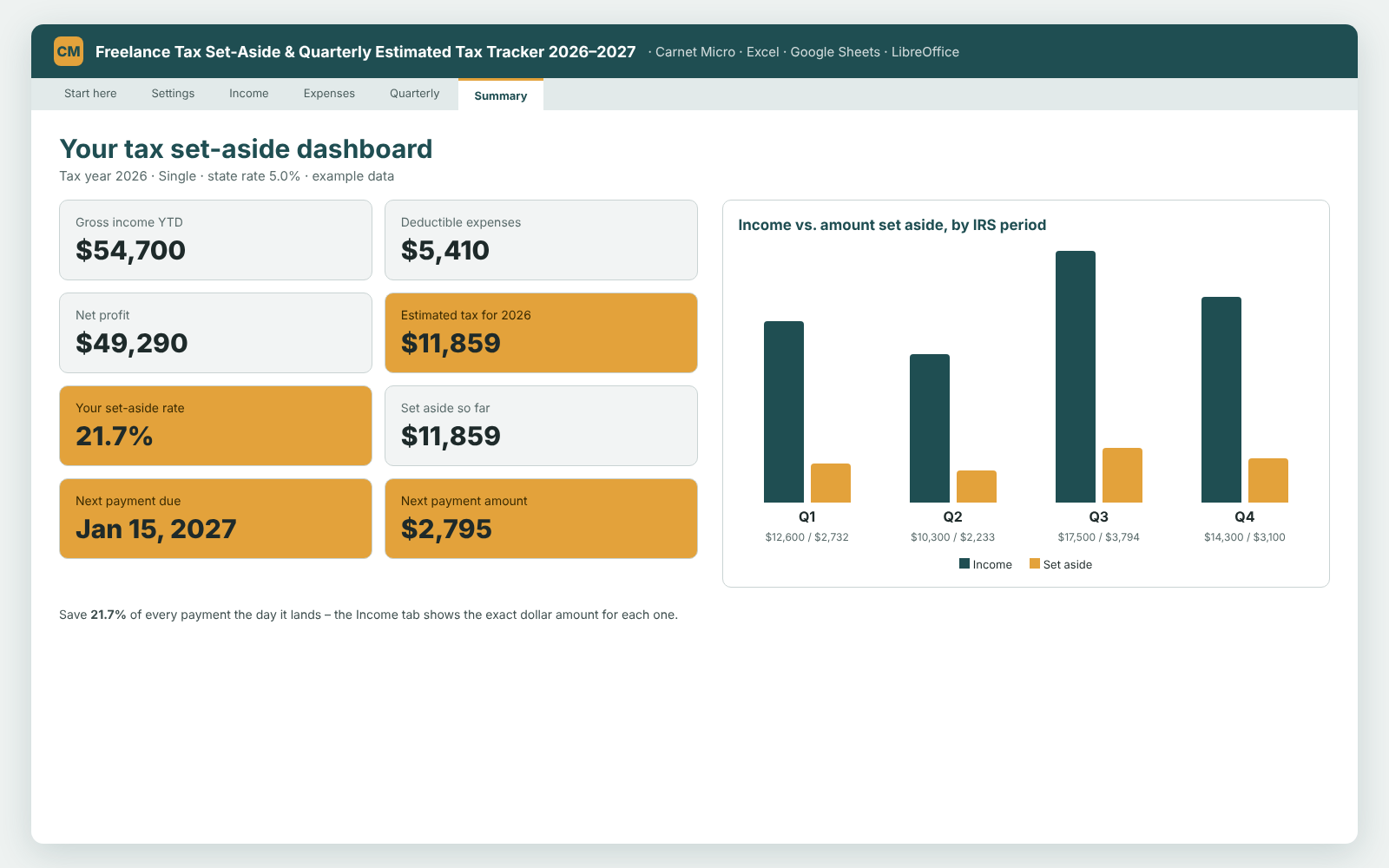
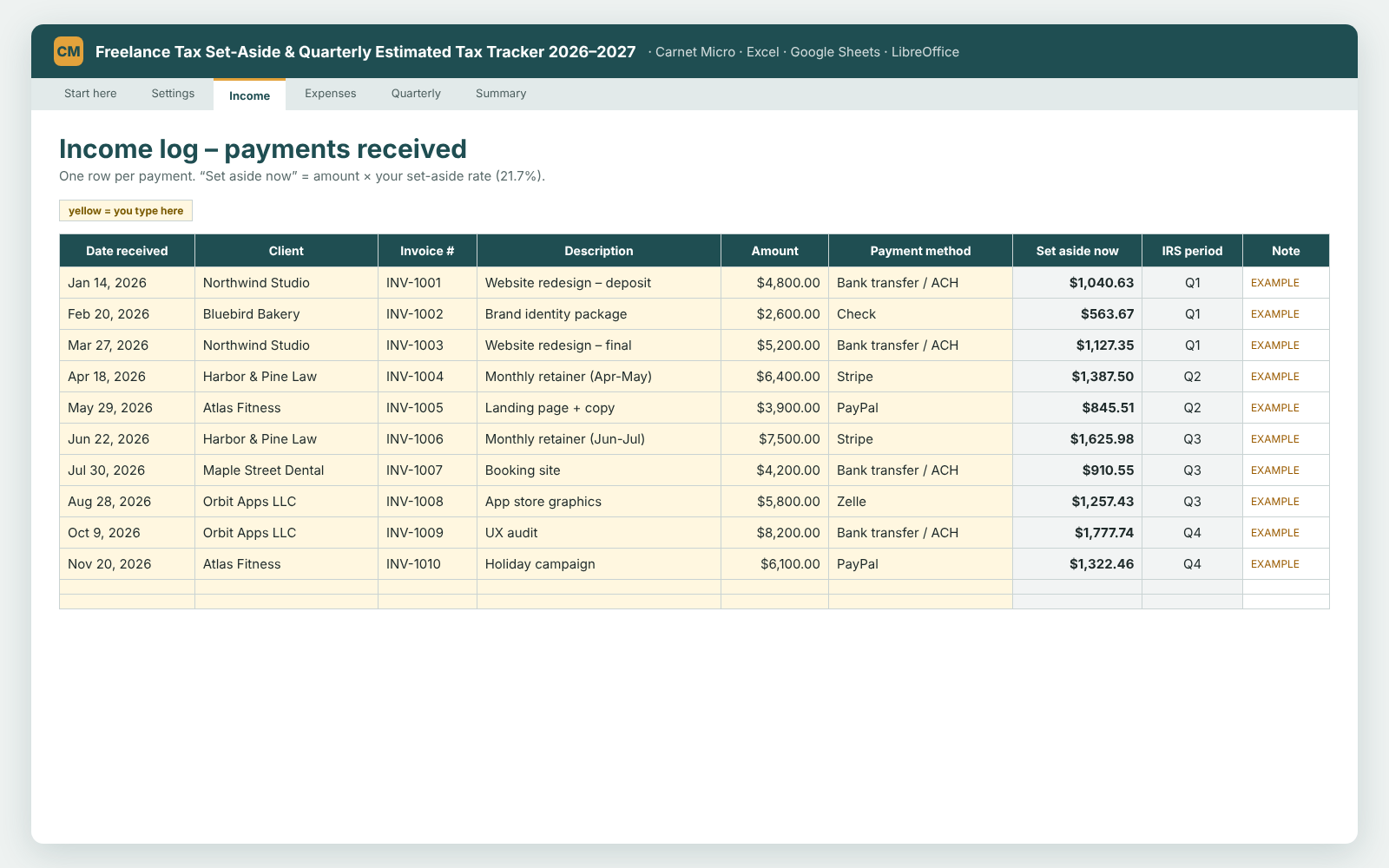
It depends on your profit, filing status and state. Self-employment tax alone is 15.3% of 92.35% of net earnings (about 14.1%), before federal and state income tax. Many freelancers end up between 20% and 30% of gross income. In the example file (single, $49,290 net profit, 5% state tax) the right rate is 21.7%; the tracker recalculates yours from your own numbers every time you log a payment.
When are quarterly estimated taxes due?
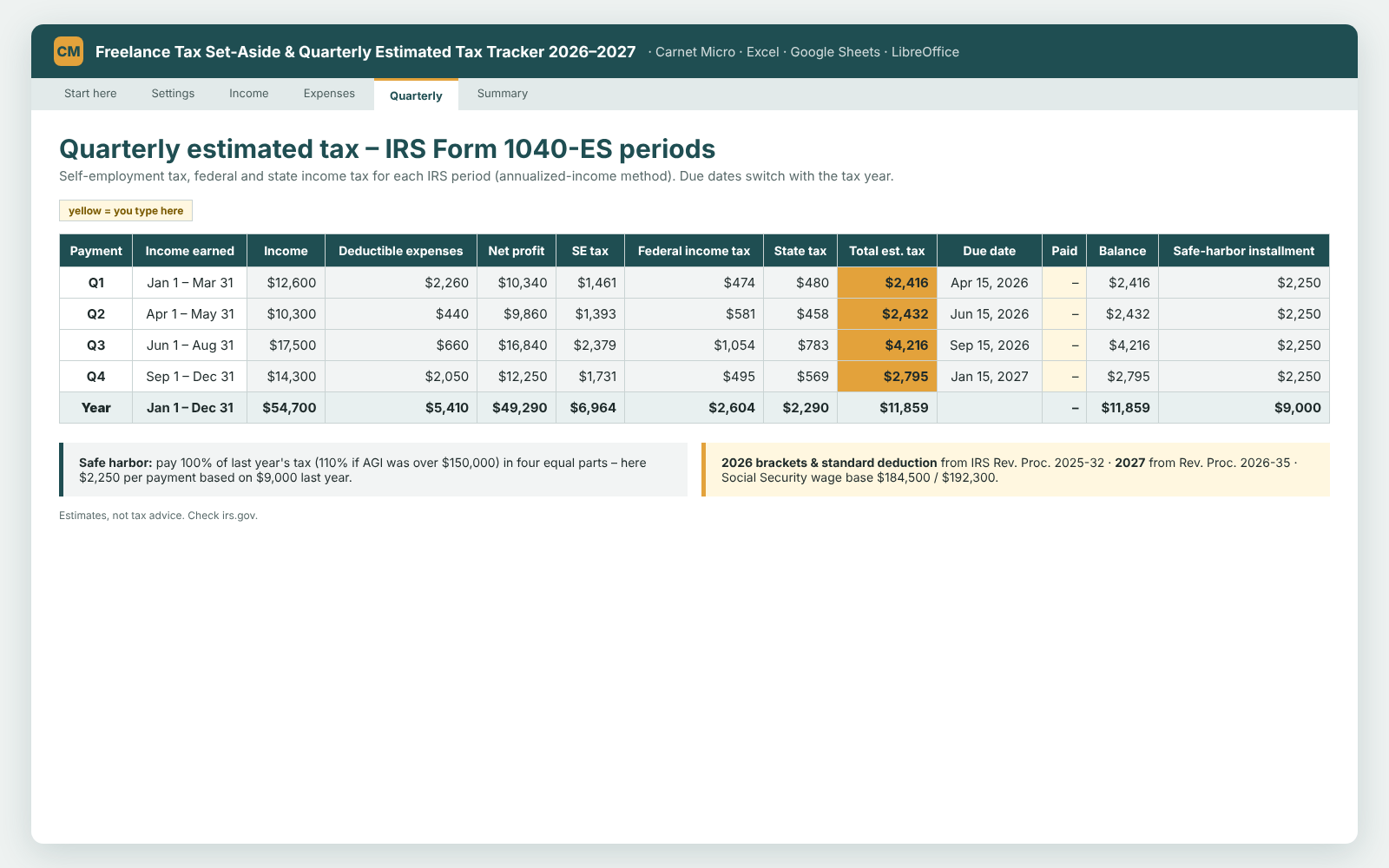
For tax year 2026: April 15, June 15 and September 15, 2026, and January 15, 2027. For tax year 2027 the file uses April 15, June 15, September 15, 2027 and January 18, 2028 (January 15, 2028 falls on a Saturday and January 17 is Martin Luther King Jr. Day).
What is the safe harbor rule?
You generally avoid the underpayment penalty if your estimated payments cover 100% of last year's total tax (110% if last year's AGI was above $150,000), paid in four equal installments. The Quarterly tab shows that amount next to the estimate based on this year's income.
Does it work in Google Sheets?
Yes. Upload the .xlsx to Google Drive and open it with Google Sheets, or use it in Excel or LibreOffice. There are no macros and no add-ons.
Which tax numbers does it use?
2026 and 2027 federal brackets and standard deductions from IRS Rev. Proc. 2025-32 and 2026-35, the Social Security wage base ($184,500 in 2026, $192,300 in 2027), 15.3% self-employment tax with the half-SE deduction, and a simplified 20% QBI deduction. All rates sit on one Settings tab and can be edited.
Is this tax advice?
No. It is an estimating and organizing tool. It does not cover credits, itemized deductions, the 0.9% Additional Medicare Tax or QBI phase-outs, and state tax is a flat rate you enter. Check irs.gov or a tax professional for your final numbers.