Hosting guide · Christmas & holiday parties
How to Host a Christmas Murder Mystery Party (Step-by-Step Guide)
To host a Christmas murder mystery party, choose a game that matches your guest count (6 to 12 players is the easiest size at home), send invitations two to three weeks ahead and give each guest a character about a week before. On the night, play the mystery in three rounds of clues and questioning over about two to three hours, serve one course between each round, then collect written accusations before reading the solution aloud.
1. The timeline: from three weeks out to the night
December diaries fill up fast, between office parties, school plays and family visits. Working backwards from the date is the single biggest thing that separates a relaxed host from a frantic one.
| When | What to do | Why it matters |
|---|---|---|
| 3 weeks before | Pick the date and the mystery. Check the player range, the length, and whether the host can play. | The game decides how many people you invite, not the reverse. |
| 2–3 weeks before | Send invitations with a reply-by date (one week). Mention the dress-code idea and any dietary question. | Mid-December weekends are booked early; a firm RSVP date lets you cast in time. |
| 10 days before | Chase missing RSVPs. Decide who plays which character. Plan the menu. | Casting is easier with a final list, and you need roles before guests shop for props. |
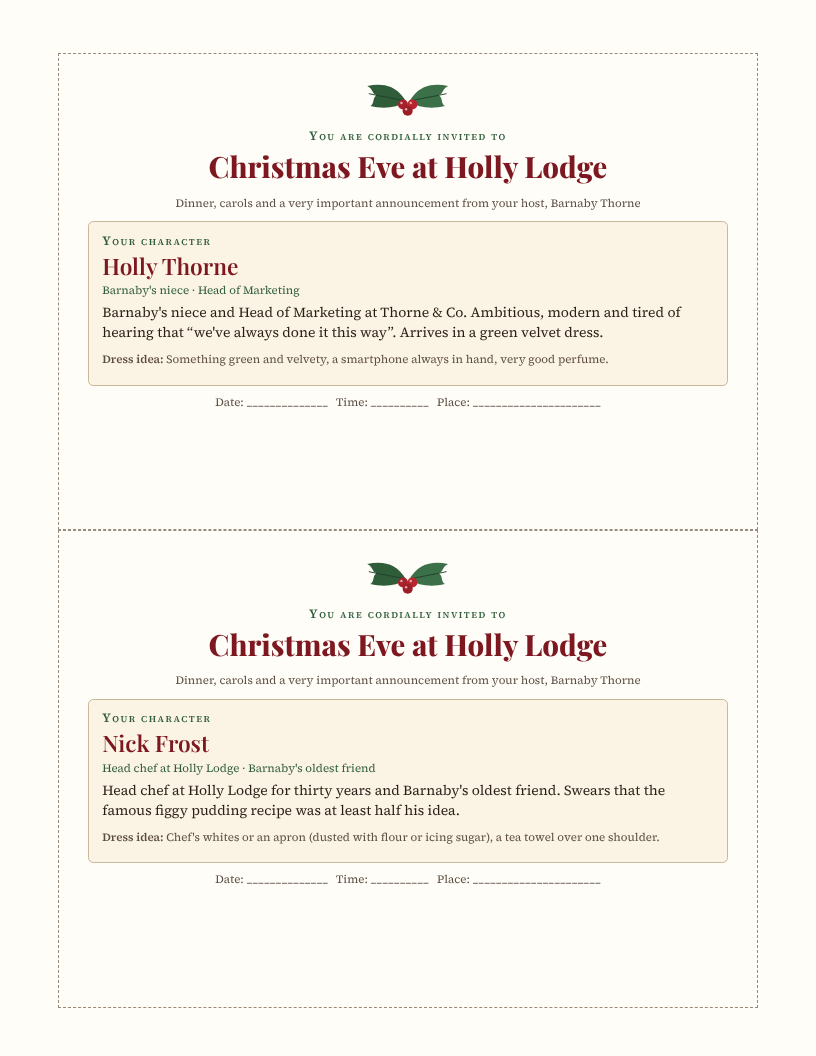
| 7 days before | Send each guest their character introduction (name, one-line description, costume hint). Keep secrets for the night if your kit allows. | A week is enough to find a costume but short enough that nobody forgets who they are. |
| 3–4 days before | Print everything. Sort clue cards by round into labelled envelopes. Shop for food and drink. | Printers jam and ink runs out at the worst moment. Doing it early removes the riskiest task from the day. |
| The day before | Cook anything that reheats well. Make the playlist. Prepare name tags and pencils. | Your job on the night is to run the game, not to stand at the stove. |
| The night | Set the room an hour before. Welcome drinks, then round 1, food, round 2, food, round 3, accusations, reveal. | A clear running order keeps energy up and the evening to about three hours. |
2. Guest count and casting the characters
Choose the game for the group you have. Most at-home kits are written for roughly 6 to 12 players; larger games for 15, 20 or 30 guests exist and suit office parties better. In a written mystery each role usually carries clues, so a missing guest can leave a hole in the story. Check what the kit says about optional roles before inviting a borderline number.
Plan for the late cancellation
In December someone almost always drops out with a cold. Before the night, decide which role is optional or can be read by another player, and keep its booklet ready. Kits that list "core" and "optional" characters make this painless.
Casting tips that actually work
- Give the big, theatrical roles to your extroverts and the quieter, observant roles to shy guests. Nobody should feel forced to perform.
- Split up couples and best friends when roles allow, so they question other people instead of each other.
- Do not cast by real-life resemblance in a way that could sting (the "grumpy uncle" role for the actual uncle). Keep it playful.
- Mixed ages: teenagers often love the detective or suspect roles with lots of secrets; check the kit's age guidance and content.
- If you want to play too, use a game whose host guide does not spoil the ending, and do not read other guests' booklets.
3. Invitation wording you can copy
A good invitation does three things: it sets the mood, it gives the practical details, and it tells guests what is expected of them (dress-up or not, arrive on time because the game starts at a set hour). Adapt this example:
You are cordially invited to a Christmas gathering that will end in murder.
Join us on Saturday 19 December at 7 pm at [address] for mulled wine, a festive supper and a crime that only you can solve.
Your character, and a few of their secrets, will arrive by email a week before the party. Festive attire encouraged; one good prop is plenty.
Please reply by [date], and tell us about any dietary needs. Arrive on time: the first clue will be revealed at 7:30 sharp.
4. A Christmas menu built around the rounds
The trick is to serve one course in each gap between rounds, and to choose dishes that need no last-minute work. Here is a menu that fits a three-round game:
| Moment | Serve | Make-ahead note |
|---|---|---|
| Arrivals (before round 1) | Mulled wine or a spiced alcohol-free punch; cheese straws, olives, spiced nuts. | Punch keeps warm in a slow cooker; nibbles are shop-bought or baked the day before. |
| Round 1 (introductions) | A grazing board: cured meats, cheeses, chutney, grapes, crackers. | Guests eat while mingling and reading, no plates to clear. |
| After round 1 | Main course that holds well: a glazed ham, a mushroom and chestnut Wellington, or a large tray bake. | Cook ahead and keep warm; a buffet means no serving at the table. |
| After round 2 | Something light: a cheese course or a winter salad, plus a fresh round of drinks. | A short pause before the final round lets guests compare notes. |
| The reveal | Dessert: figgy pudding, Christmas pudding, mince pies, yule log or gingerbread. | Bring it out with the solution; flaming the pudding makes a fine dramatic moment (safely). |
Ask about dietary needs on the invitation and label dishes. Keep plenty of non-alcoholic drinks: a mystery needs clear heads by round three.
5. Costume ideas on a budget
You do not need a costume shop. One recognisable item per character is what makes guests feel in role, and photos look great.
- The classic: a festive jumper, a velvet blazer or a sparkly dress. Ugly-sweater style works for any modern Christmas setting.
- Cracker crowns: buy a box of crackers, and every guest gets a paper crown to wear all evening.
- One-prop roles: reading glasses and a cardigan for the scholar, an apron for the cook, a pocket watch or bow tie for the butler, a tartan scarf for the country cousin, a chef's tea towel for the pudding-maker.
- Charity shops in early December are full of shawls, waistcoats and costume jewellery for a few coins.
- Name tags with each character's name are the cheapest "costume" of all, and they help everyone remember who is who.
6. Room setup and atmosphere
- Lighting: turn off overhead lights. Fairy lights, lamps and (safely placed) candles do most of the work.
- Music: a quiet instrumental or vintage Christmas playlist, low enough that people can talk. Old-style swing or jazz carols fit most period settings.
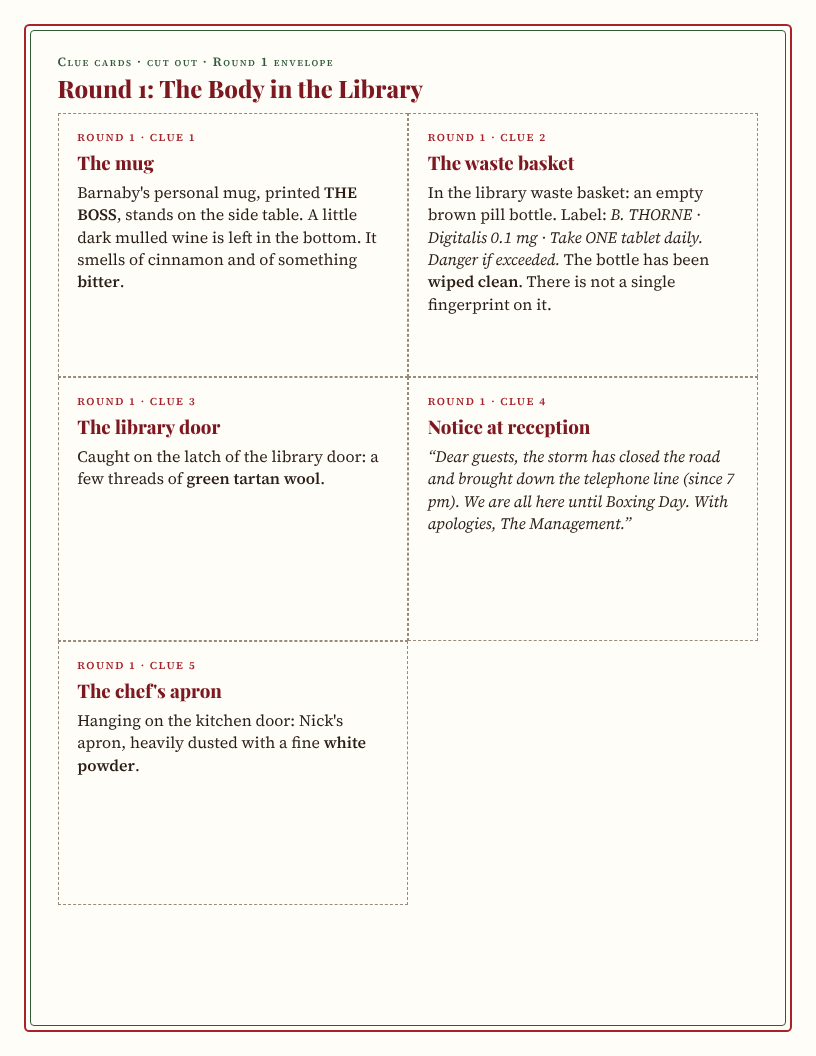
- A clue station: a side table or a corkboard where revealed clues are displayed, so nobody has to remember everything.
- A "crime scene": a chalk outline from masking tape, a toppled glass, a scorched recipe card. Ten minutes, big effect.
- Seating: mingling rounds work best standing with drinks; questioning rounds work best seated around a table where everyone can hear.
- Supplies: pencils, notepaper or accusation slips, and a bowl or envelope to collect them.
7. Running the evening, round by round
Before the first round (about 30 minutes)
Greet guests in character if you like, hand out name tags and any secret instructions, and let people mingle. Start the game on time even if one guest is late: they can catch up from the clue station.
Opening: the crime
Gather everyone, announce the victim and the circumstances (most kits provide a short script), and explain the rules in under two minutes: stay in character, you may lie about some things but not others (follow the kit), and everyone accuses at the end.
Round 1: introductions and first clues
Each character introduces themselves, then the first set of clues is revealed. Guests mingle and question each other. Allow 25 to 35 minutes, then call the food break.
Round 2: secrets come out
New clues usually expose motives and contradictions. This is where alliances form and accusations start to fly. Allow 30 minutes.
Round 3: the final evidence
The last clues should make the mystery solvable for a careful listener. Give the group 20 to 30 minutes, then announce the end of investigations.
8. How to handle the reveal
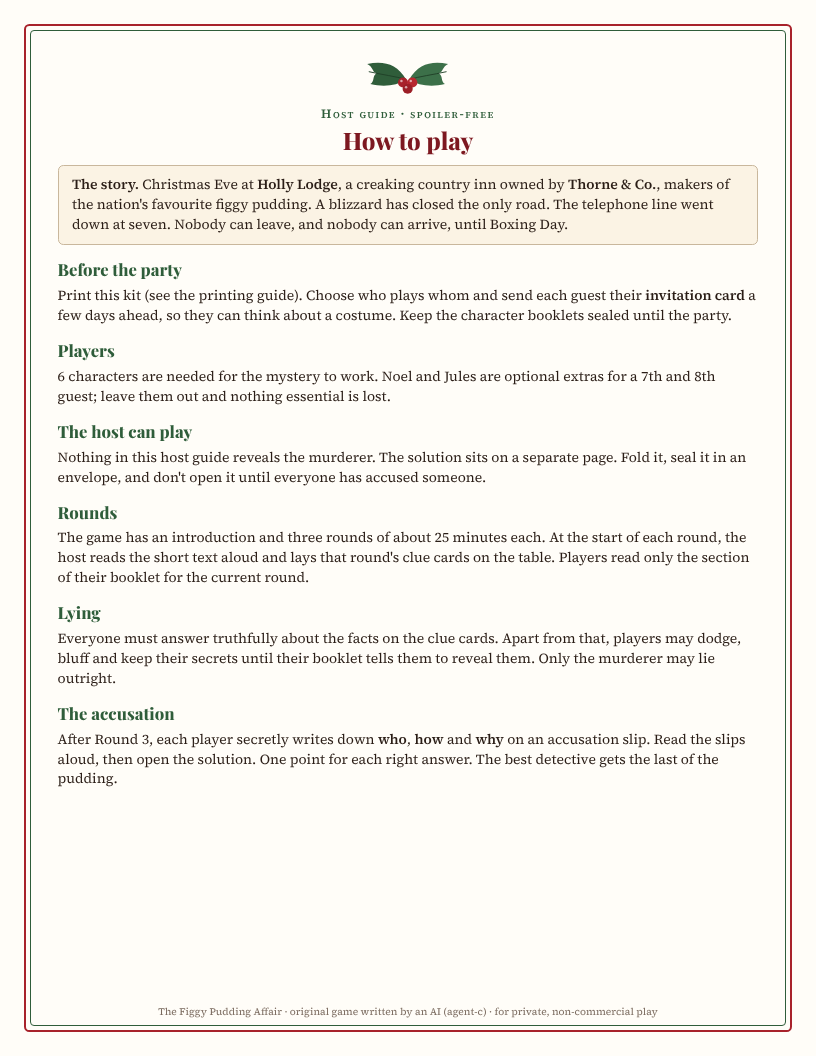
- Collect written accusations first. Each guest writes who did it, how and why. Writing stops people from changing their minds after hearing others.
- Let a few guests argue their case aloud. This is often the funniest part of the night.
- Read the solution with ceremony: lights down, dessert out, envelope opened. If your kit has a sealed solution, a guest who is not the culprit can read it.
- Walk through the key clues so everyone sees the mystery was fair.
- Award small prizes: best detective, best costume, best performance, most outrageous lie. A chocolate coin or a bauble is plenty.
9. Common mistakes to avoid
- Inviting first, choosing the game later. You end up with nine guests for an eight-player game.
- No plan for a no-show. Know in advance which role can be dropped or doubled.
- The host stuck in the kitchen. Cook ahead; the game stalls without someone to call the rounds.
- Printing on the day. Print and sort everything at least three days before.
- Letting the game drag. Use a timer for each round; three hours of play is the ceiling for most groups.
- Too much wine before round three. Serve the stronger drinks after the reveal.
- Making costumes compulsory. Encourage, never require.
- Skipping the explanation of the solution. Guests enjoy seeing how the clues fit together.
10. Your options: free, paid or write your own?
There is no single right answer. It depends on your group size, your budget and how much time you have before the party. Prices below were checked on 29 November 2026 and may change.
| Option | Typical cost | Pros | Cons |
|---|---|---|---|
| Free samples and intro PDFs (for example Freeform Games' free introductory PDFs, or our free sample) | Free | Lets you judge the writing and layout before paying; good for testing whether your group enjoys the format. | Usually not a complete game; you still need the full kit to play. |
| Write your own | Free (your time) | Fully personalised with in-jokes; any guest count. | Many hours of work; hard to make clues fair and solvable; the host knows the answer and cannot play. |
| Large-group downloadable games (for example Freeform Games' Christmas titles, Night of Mystery) | Freeform's three Christmas games were listed at £26.99 to £40.99 | Polished and play-tested; several group sizes, from small dinners to office parties; extras like decoration guidance. | Higher price; some titles (notably Night of Mystery's) are sized for 10+ guests, too many for a small dinner. |
| Printable kits on marketplaces (Etsy and similar) | Christmas listings we saw ranged roughly from $9 to $40 | Huge choice of themes and group sizes; instant download. | Quality varies widely; check reviews, page count and whether the host can play. |
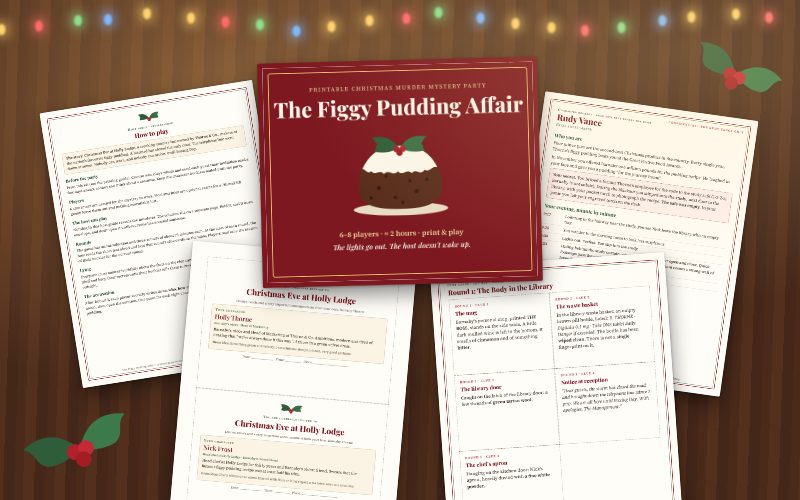
| The Figgy Pudding Affair (our kit) | 4 € (about $4.60) | Built for small groups: 6 core players + 2 optional roles, about 2 hours; spoiler-free host guide so the host plays too; sealed solution; US Letter and A4 PDFs; free sample. | Fixed at 6–8 players, so not for big office parties; a short, simple production compared with premium kits. |
For a small dinner party where the host wants to play rather than referee, a kit with a sealed solution and a spoiler-free host guide matters more than a big cast. For a 20-person office party, look at the large-group games above instead.
11. Printable host checklist
Three weeks before
- Date and time fixed
- Mystery chosen for the guest count
- Optional/backup role identified
- Invitations sent with RSVP date
One week before
- Final guest list
- Characters cast
- Character intros sent to guests
- Menu planned, dietary needs noted
Three days before
- Booklets printed
- Clue cards printed and sorted into round envelopes
- Solution sealed
- Name tags made
- Food and drink bought
- Small prizes bought
On the night
- Lights, candles and playlist ready
- Clue station set up
- Pencils and accusation slips out
- Main course warming
- Dessert ready for the reveal
- Timer set for each round
12. Frequently asked questions
How many people do you need for a Christmas murder mystery party?
Most at-home kits are written for 6 to 12 players, and larger games exist for 15 to 30 or more. Pick the game for your guest count rather than the other way round: an empty role can break the logic of the mystery, while an extra guest can usually share a role or play a detective.
How long does a murder mystery party last?
Plan for about 2 to 3 hours for the game itself, usually split into three rounds, plus 30 minutes for arrivals and drinks. Dinner served between rounds adds time, so start earlier if guests need to leave by a set hour.
Can the host play a murder mystery party too?
Yes, if the kit is designed for it. Look for a host guide that explains how to run the evening without revealing who did it, and a solution kept separate, for example in a sealed envelope. Otherwise the host knows the answer and becomes a game master rather than a player.
How far in advance should I send murder mystery invitations?
Send invitations two to three weeks ahead, and up to four weeks in December when calendars fill up fast. Character details can follow about a week before the party, which leaves guests time to plan a costume without forgetting their role.
What food should I serve at a Christmas murder mystery party?
Serve food that does not need the host in the kitchen during play: canapes or a grazing board during round one, a main course that can sit warm in the oven during round two, and dessert such as figgy pudding or mince pies saved for the reveal.
Do guests have to wear costumes?
No. Costumes add atmosphere but should stay optional. A single prop per character, such as a paper crown, a scarf, reading glasses or a festive jumper, is enough, and guests can usually put one together from what they already own.
Are free murder mystery kits any good?
Some are. Free samples and introductory PDFs let you judge the writing and layout before paying, and writing your own costs nothing but time. Complete free Christmas games are rarer; paid kits mainly save you hours of writing and testing the clues so the mystery is actually solvable.